Buying guide
Best plug-in heaters in the UK: how to choose
The short answer
Plug-in heaters are the cheapest way to make one cold room usable without heating the whole house. Look for 900–1,500 W with a thermostat, a timer and overheat protection — and ignore anything promising instant whole-room warmth.
Written and checked by the RapidHeat UK team · Last updated February 2026 · how we work out running costs
Key takeaways
- Ignore "heats any room in 2 minutes" claims — check wattage, thermostat, timer and safety cut-offs instead.
- Anything sold as plug-in must run from a normal 13 A socket, never an extension lead.
- For most UK rooms, 900–1,500 W with a thermostat is the sweet spot.
What we would buy
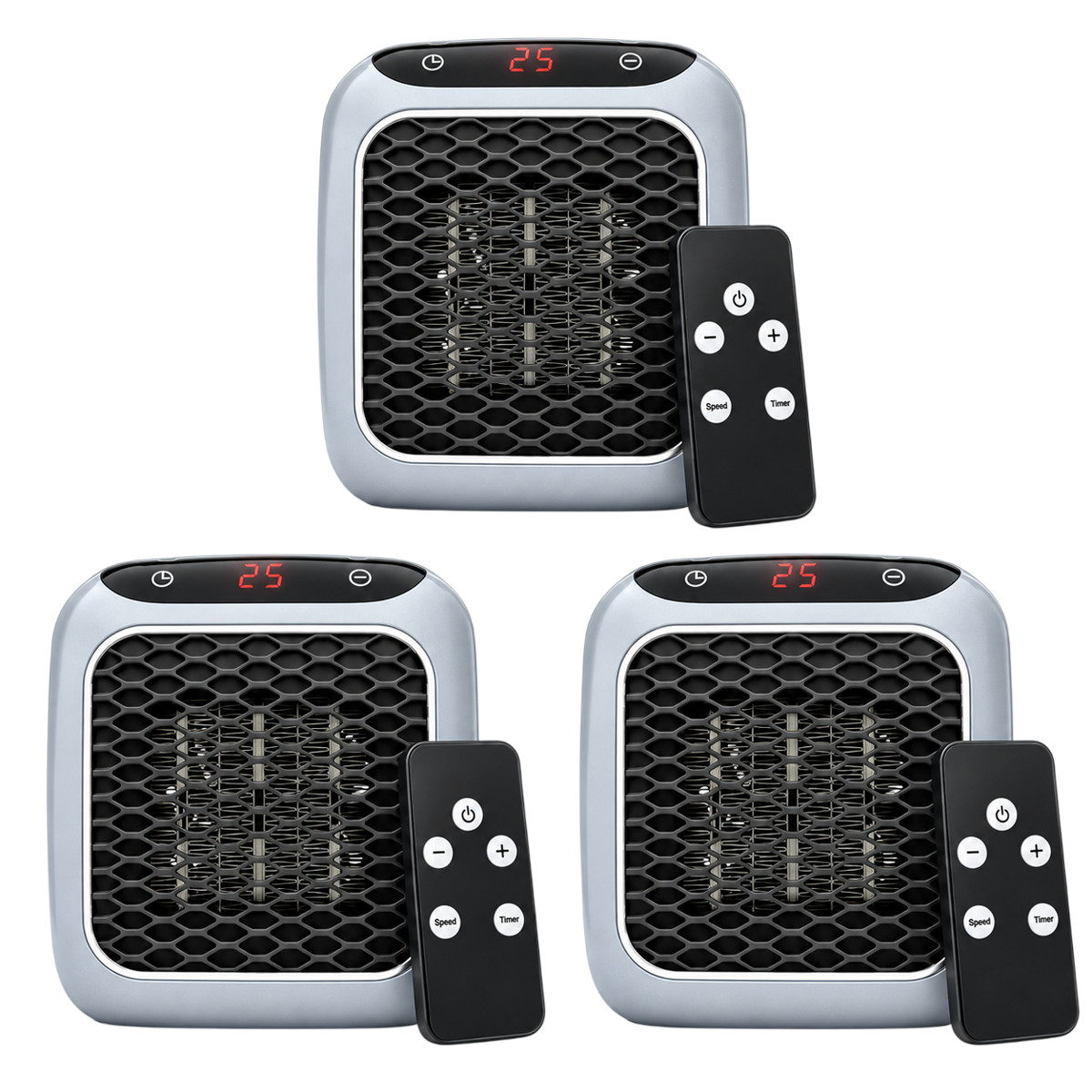
If you only want the answer: for a single cold room, a thermostatic ceramic plug-in heater around 1,200 W with a timer and a remote does the job for the least money — that is one RapidHeat at £49.95. If more than one room is cold, the multi-heater bundles drop the price per heater sharply, which is why most people here buy two or three rather than one.
Best for one cold room
1 RapidHeat
£49.95
A home office, a single bedroom or a bathroom used for short spells. Thermostat, timer and remote, so it is not running at full power all evening.
Best for most households
2 RapidHeats
£89.91 · £44.96 per heater
Two rooms warmed without carrying a heater up and down stairs — usually a bedroom plus a home office. The cheapest step up per heater.
Best value per heater
3 RapidHeats
£110.89 · £36.96 per heater
Bedroom, office and living room covered, so the central heating stays off on mild days. Lowest price per heater of the four options.
Best for a whole flat or house
4 RapidHeats
£119.88 · £29.97 per heater
One heater per room means nobody is waiting for the warm room to be free, and the boiler only comes on when the whole house genuinely needs it.
Every option ships free within the UK with a 30-day money-back guarantee. You buy direct from RapidHeat UK, and the prices above are exactly what our checkout charges.
Where a plug-in heater is the wrong answer
- A conservatory in mid-winter — glass loses heat faster than a 1.2 kW heater can add it.
- An uninsulated garage or workshop — an infrared panel heats you rather than the whole volume.
- All-night background warmth — use a timer for the first hour instead; we do not recommend leaving any heater running while you sleep.
- Open-plan kitchen-diners or a whole house — this is single-room heating, not a boiler replacement.
Start with the job, not the product
Almost every disappointing plug-in heater purchase comes from a mismatch of job and product. A small plug-in heater is designed to take the chill off a single room of roughly 8 to 12 m² — a bedroom, a home office, a bathroom, a study, a conservatory in spring or autumn. It is not designed to warm an open-plan kitchen-diner or replace central heating for a whole house. Get that expectation right and the rest of the decision is straightforward.
The three types you will see
Ceramic (PTC) heaters
A ceramic element heats up in seconds and a small fan pushes that warmth into the room. They reach comfortable temperature fastest, they are compact, and the good ones are quiet. Because the element self-regulates, it does not glow red hot the way old bar heaters did. This is the type most plug-in heaters sold in the UK now use, including RapidHeat.
Fan heaters
Often cheap and fast, but noise and controls vary. Some entry-level models omit a true thermostat or timer, so check the exact specification and full-power wattage before buying.
Oil-filled radiators
Slow to warm up, slow to cool down, silent, and better for a room you want warm for many hours. They are heavy and take floor space, and they are not really "plug-in and move around" devices. We compare them in detail in our ceramic vs oil-filled guide.
What wattage do you need for your room?
A rough rule works well for an average insulated UK room: about 100 W per square metre. Add roughly 30% for a conservatory, a room over a garage or anything with single glazing. Costs below use 27p per kWh at full power — a thermostat cuts the real figure once the room is up to temperature.
| Room size | Suggested power | Cost per hour at full power |
|---|---|---|
| Up to 6 m² (desk, small study, caravan) | 500–900 W | 14p–24p |
| 6–10 m² (single bedroom, bathroom) | 900–1,200 W | 24p–32p |
| 10–14 m² (double bedroom, home office) | 1,200–1,500 W | 32p–41p |
| 14–20 m² (living room) | 1,500–2,000 W | 41p–54p |
| Over 20 m² or open plan | Not a plug-in heater job | — |
Our running costs guide works through the same maths hour by hour, and cheapest way to heat a room compares it against turning the boiler on. Shopping for ceramic specifically? Read our ceramic heater UK guide.
RapidHeat from £49.95
Free tracked UK delivery · 30-day money-back guarantee
The 10-point checklist before you buy
- An adjustable thermostat, not just a power dial. Without one the heater runs at full power the entire time it is on, so it will always cost more.
- A timer. Warms the bathroom before a shower or the bedroom before bed without running all evening. Anything that switches itself off pays for itself over a winter.
- Wattage matched to the room using the table above — not the biggest number on the box.
- Overheat protection with automatic shut-off. Non-negotiable near soft furnishings.
- Tip-over cut-off on any free-standing unit used around children or pets.
- Remote control. Sounds like a gimmick until you own one — it is what makes people actually turn the heat down.
- Quiet operation if the room is a bedroom or you take calls in it.
- A UK three-pin plug with CE or UKCA marking. Avoid grey imports that need a travel adaptor.
- Weight and a handle if you plan to move it between rooms; anything you cannot carry one-handed stays put forever.
- A UK returns address and a real warranty. Check this before you pay, not after.
What does not matter as much as the marketing suggests
- Very high wattage. More watts is not "better heating", it is simply more electricity per hour. What matters is whether the heater can reach your target temperature and then hold it.
- Ionisers and mood lighting. Nice to have, irrelevant to warmth.
- "Heats a room in 2 seconds" claims. The element can get hot in seconds; a room takes minutes. Any product promising instant whole-room warmth is overselling.
Match the type to the room
| Room | Best type | Why |
|---|---|---|
| Home office / desk | Small thermostatic ceramic | Warm in a minute, low power, sits under a desk |
| Bedroom | Ceramic with timer, or oil-filled | Timer for the first hour; oil-filled if noise bothers you |
| Bathroom | Ceramic, well away from water | Fast heat for a short spell; never within reach of a bath or shower |
| Conservatory | Infrared or higher-wattage convector | Glass loses heat faster than the air can be warmed |
| Garage / workshop | Infrared panel or industrial fan heater | Heats you and the bench, not the whole uninsulated volume |
| Caravan | Low-wattage ceramic | Stays inside a limited hook-up supply |
Room-by-room detail: bedroom, bathroom, desk, conservatory, garage and caravan.
Mistakes that make plug-in heating expensive
- Buying 2 kW because it sounds powerful, then running it in a 9 m² room with the door open.
- Leaving a heater on low all day "to keep the chill off" instead of using a timer.
- Heating a room with an uninsulated loft hatch or a gap under the door — draught-proofing costs a few pounds and saves more than any heater setting.
- Running two heaters off one extension lead. Use separate wall sockets; a 13 A heater should always go directly into the wall.
Where RapidHeat fits
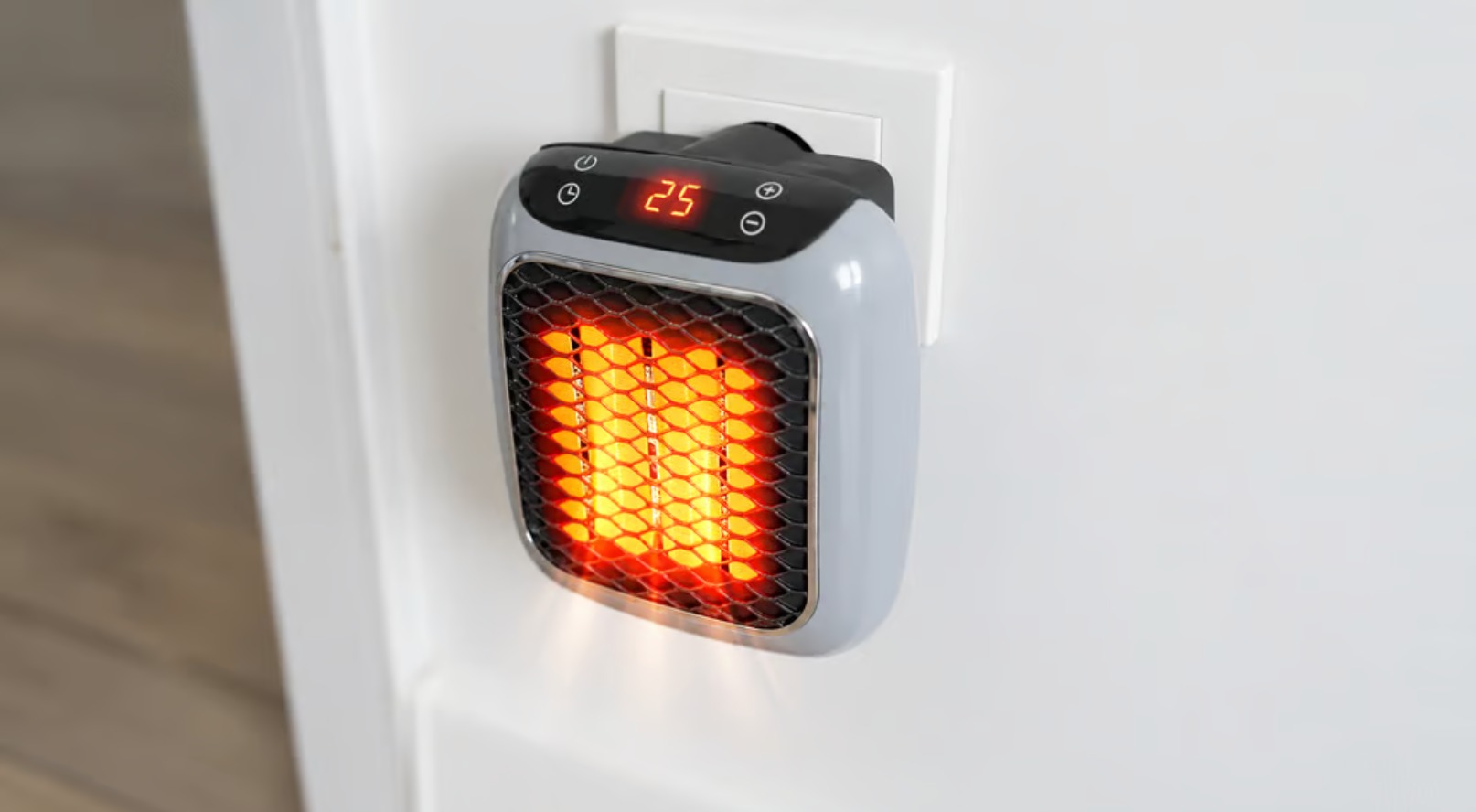
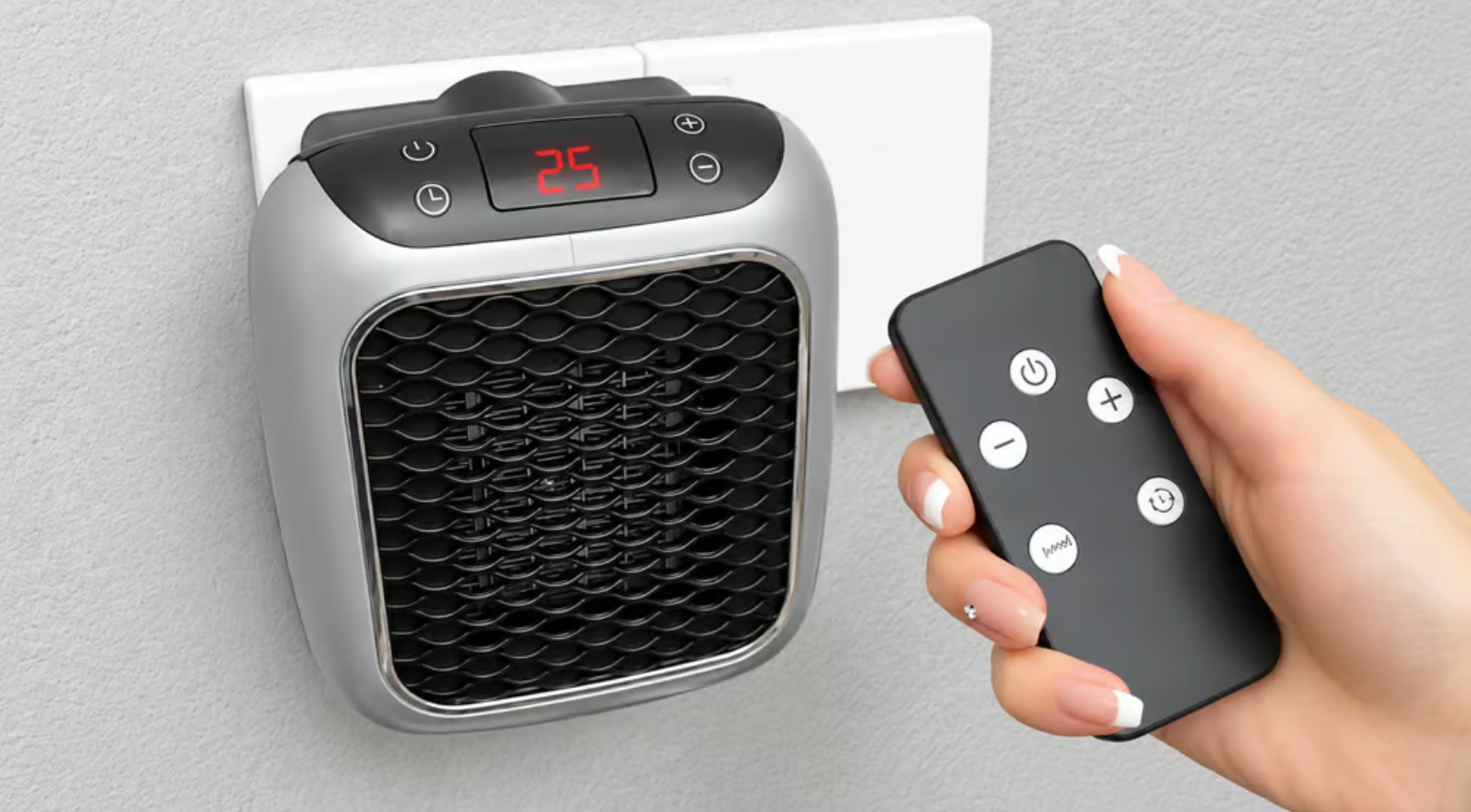
RapidHeat is a ceramic plug-in heater built for exactly the single-room job described above: it warms a space of up to about 12 m² in roughly five minutes, has an adjustable thermostat, a timer, overheat protection with automatic shut-off, and a remote control. It plugs into a standard socket with no installation.
Buy it if
- One or two rooms are colder than the rest of the house
- You want warmth in minutes, not in half an hour
- You want a thermostat, timer and remote for under £60
Skip it if
- You need to heat an open-plan space or a whole house
- You want silent heat all night — choose oil-filled
- The space is an uninsulated garage or a winter conservatory
See how it compares to the alternatives, read what UK customers say, or check current prices.
How we rate heaters here
We sell one heater, so treat this as a buying framework rather than an independent shoot-out: the criteria above are the ones that decide comfort and cost, and we have set out plainly where a ceramic fan heater is the wrong answer. For the honest limits of ours, read is RapidHeat any good.
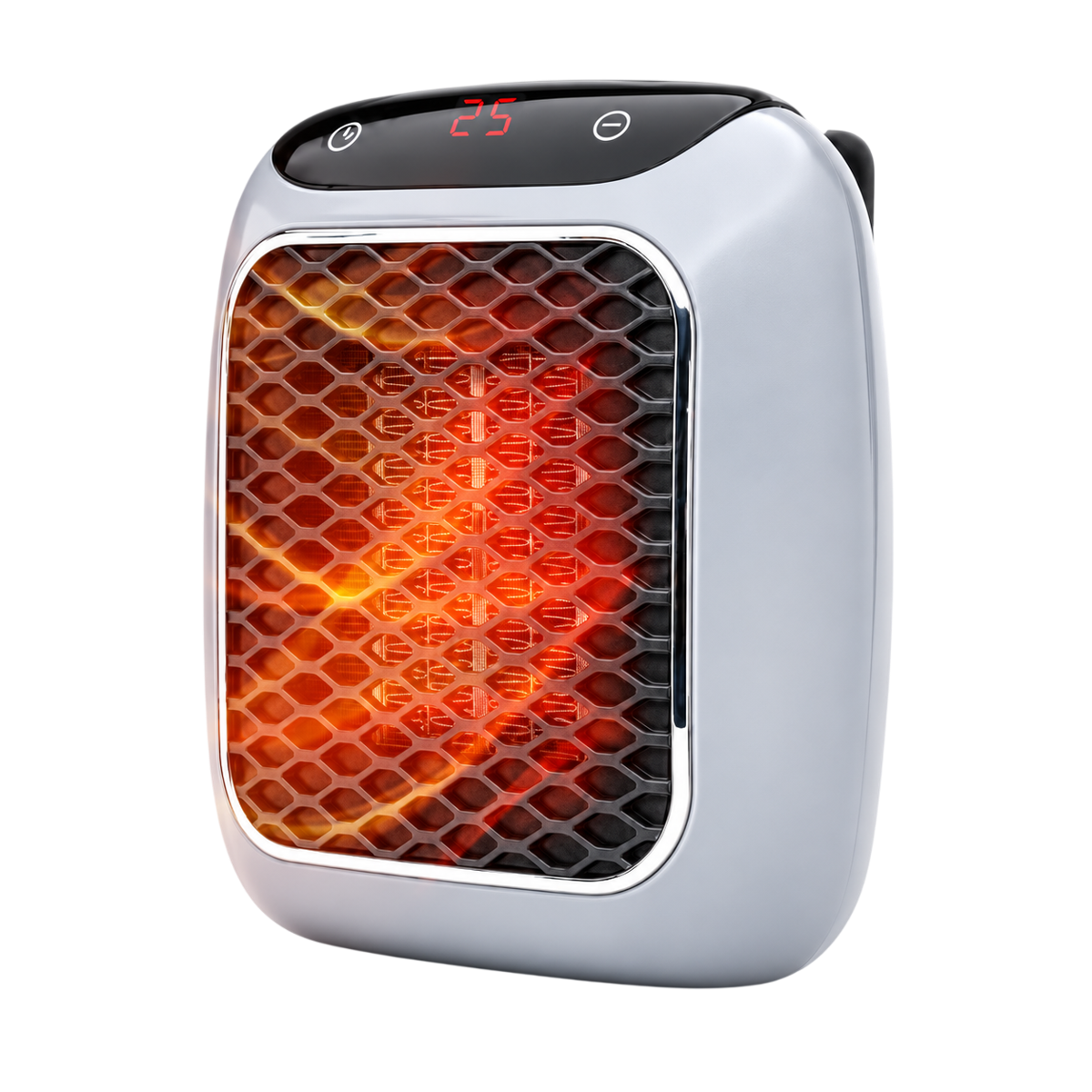
RapidHeat ceramic heater
4.8/5 · 1,247 UK customers£49.95· £89.91 for two · £110.89 for three (about £36.96 each)
- Thermostat, timer and remote
- Warm room in about 5 minutes
- Free tracked UK delivery
- 30-day money-back guarantee





Perfect for my cold office
I have a small office with a door that gets really cold because the building management keeps the winter temperature far too low for comfort. I plugged this into the socket above my desk and now I am warm without anyone even knowing it is there. I love it.
Great in the bathroom
We use it to take the chill off the bathroom before the kids' bath time. Warms up fast and the timer is handy. Four stars only because I wish the display were a little dimmer at night.
Worth being straight about: RapidHeat is built for rooms up to about 12 m². It is not a replacement for central heating and it will not transform an open-plan lounge or an uninsulated garage. If it is not right for your room, send it back within 30 days.
Questions people ask
- What should I look for in a plug-in heater?
- Wattage suited to the room, an adjustable thermostat, a timer, overheat protection, a tip-over switch on free-standing units, and CE or UKCA marking. Everything else is comfort and convenience.
- Are cheap plug-in heaters any good?
- Very cheap units usually cut the thermostat, which is exactly the part that keeps your bill down. Paying a little more for temperature control tends to pay for itself over a winter.
- Do plug-in heaters that claim to be 'energy saving' work?
- No heater produces more heat than the electricity it uses. Savings only come from heating one room instead of the house, and from a thermostat and timer limiting how long the element runs. Treat any other claim with suspicion.
- How many plug-in heaters can I run at once?
- Keep each one on its own wall socket, and be careful running two 2,000 W heaters on the same circuit alongside a kettle. Lower-wattage heaters in separate rooms are the safer approach.
- What is the best plug-in heater for a bedroom?
- One with a timer and a thermostat, quiet enough to sleep near. A ceramic heater on a timer that warms the room for 45 to 60 minutes before bed suits most people; choose an oil-filled radiator instead if you need total silence all night.
- Are plug-in heaters expensive to run?
- It depends entirely on power and hours. At around 27p per kWh, a 1,200 W heater costs roughly 32p an hour at full power, and much less once a thermostat starts cycling it off. Heating one room this way is usually cheaper than firing up central heating for the whole house.
- What is the best low-wattage plug-in heater?
- For a desk, small study or caravan hook-up, look at 500 to 900 W with a thermostat. Lower wattage takes longer to warm a room but costs less per hour and is less likely to trip a limited supply.
- Are plug-in heaters worth it?
- Yes, for one cold room you use for a few hours a day. They are poor value if you try to heat a large open space, an uninsulated garage or the whole house with them.
Warm one room properly, from £49.95
Order RapidHeat today with free tracked UK delivery and a 30-day money-back guarantee.
Sold direct by RapidHeat UK. Secure checkout, free tracked UK delivery.