Cost guide
What does an electric heater actually cost to run in the UK?
The short answer
There is one formula, it takes ten seconds, and it settles most arguments about electric heating. Here it is, with a table you can use for your own heater.
The formula
Cost per hour = kilowatts × your electricity unit rate.
Your unit rate is on your energy bill in pence per kWh. A heater's wattage is on its label or in the manual — divide watts by 1,000 to get kilowatts. So a 1,200 W heater is 1.2 kW, and at 27p per kWh it costs 1.2 × 27 = about 32p an hour at full power.
Cost per hour by wattage
The table below uses an illustrative rate of 27p per kWh. Substitute your own rate — the numbers scale directly.
| Heater power | kWh per hour | Cost per hour at 27p/kWh |
|---|---|---|
| 500 W (low setting) | 0.5 | 13p |
| 800 W | 0.8 | 21p |
| 1,000 W (1 kW) | 1.0 | 27p |
| 1,200 W | 1.2 | 32p |
| 1,500 W | 1.5 | 40p |
| 2,000 W (2 kW) | 2.0 | 54p |
| 3,000 W (3 kW) | 3.0 | 81p |
Electricity prices change with the price cap and with your tariff, so always check your own bill rather than relying on a figure you read online — including this one.
Why the headline figure overstates real cost
That table assumes the heater runs flat out for the whole hour. A heater with a thermostat does not. It runs at full power until the room reaches your set temperature, then cycles the element off and on to hold it. In a small, reasonably insulated room that duty cycle is often well under half the time once the room is up to temperature — so real cost per hour lands well below the full-power number. This is the single most important thing to understand about electric heating costs, and it is why a thermostat matters more than wattage.
Electric heater vs central heating for one room
Gas is cheaper per unit of energy than electricity, so heating your whole house with electric heaters would be expensive. But that is not the comparison most people are actually making. The real comparison is:
- Option A: fire up the boiler and warm the whole house so one room becomes comfortable.
- Option B: heat only the one room you are sitting in.
If you are working from home in one room, or in a bedroom in the evening, Option B often works out cheaper simply because you are heating a fraction of the volume. Whether it does depends on your boiler, your tariff, your insulation and how many rooms you actually use — so do the sum for your own home rather than trusting a blanket claim either way.
Five ways to cut the cost
- Use the thermostat properly. Set the temperature you actually want, not the maximum. Every degree costs money.
- Use the timer. Warm the bathroom for 20 minutes before a shower rather than leaving a heater on for three hours.
- Close the door. A closed door roughly halves the volume you are heating in a typical home.
- Block the draughts. A £5 draught excluder does more for a cold room than a more powerful heater.
- Use the low power setting. Reaching temperature slightly slower on 800 W costs less than blasting 1,500 W and then opening a window.
How RapidHeat is designed around this
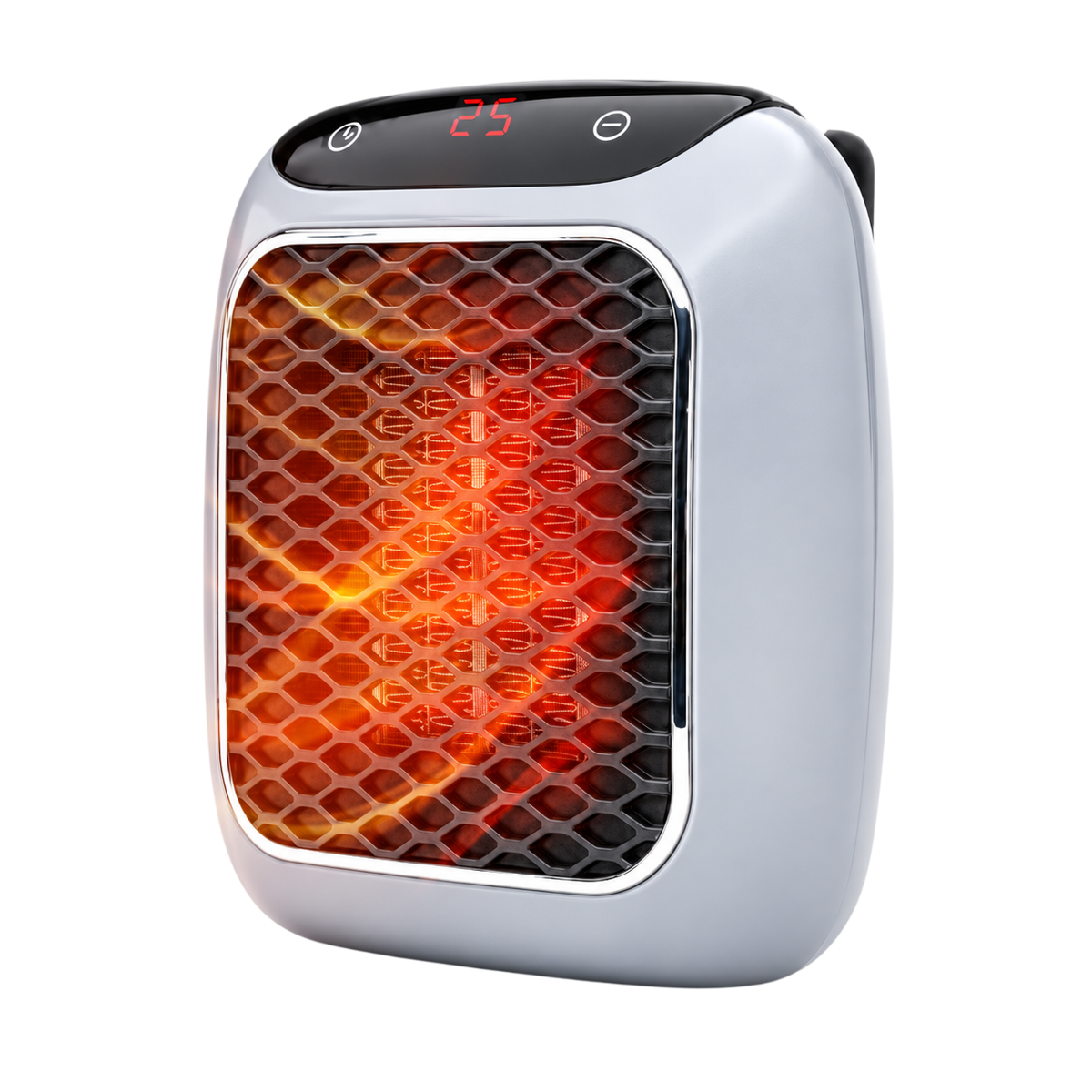
RapidHeat is built for the one-room case: it reaches a comfortable temperature in about five minutes, then its adjustable thermostat holds that temperature instead of running non-stop, and its built-in timer means you can heat only for the window you need. That combination — a small space, a thermostat, and a timer — is what keeps the number on your bill down.
Next: how to choose a plug-in heater and how to size one for your room.
Heat the room you're in, not the whole house
Order RapidHeat today with free tracked UK delivery and a 30-day money-back guarantee.